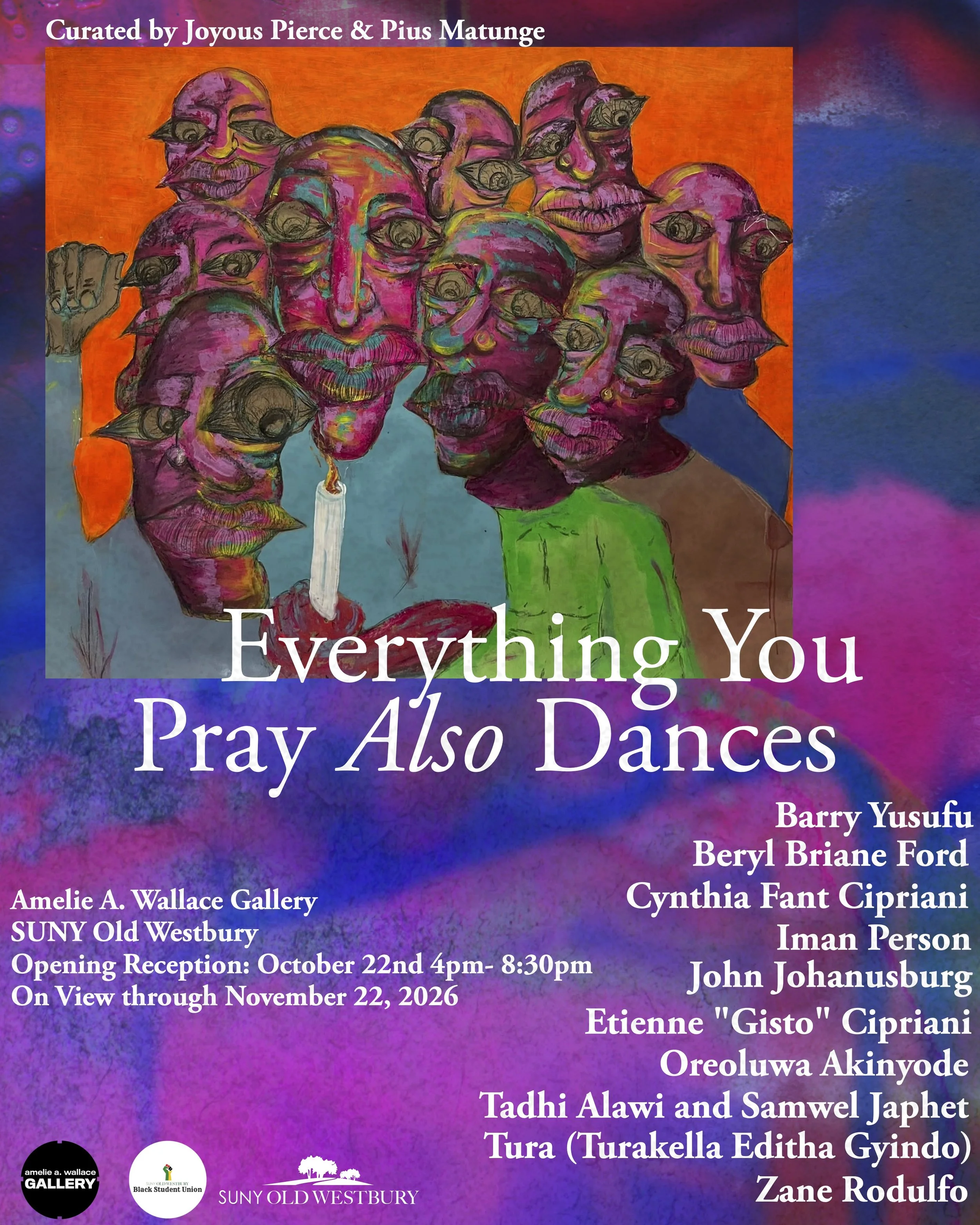
Everything You Pray Also Dances
Co-curated by Joyous Pierce and Pius Matunge
October 22 – November 22, 2026
Amelie A. Wallace Gallery, SUNY Old Westbury
The Amelie A. Wallace Gallery at SUNY Old Westbury presents Everything You Pray Also Dances, an exhibition that returns the gallery’s collection of mid-twentieth-century Makonde sculpture to public view and places it in dialogue with eleven contemporary artists from Tanzania and the Black Atlantic. Co-curated by Joyous Pierce and Pius Matunge, the exhibition presents works from the 90-piece Leon V. and Norrie Johnson Hirsch Collection alongside new and existing work by Oreoluwa Akinyode, Tadhi Alawi, Etienne “Gisto” Cipriani, Cynthia Fant Cipriani, Beryl Briane Ford, Turakella Editha Gyindo, Samwel Japhet, John Johannesburg, Iman Dayo Person, Zane Rodulfo, and Barry Yusufu. On view October 22 through November 22, 2026, with an opening reception on Thursday, October 22, at 4:00 p.m. – 8:30 p.m.
The Hirsch Collection is the gallery’s first permanent collection. Its origins lie in Dar es Salaam in the late 1960s, where Leon V. Hirsch, a Harvard-trained economist working in international development, was supervising economic development teams for United Research under the aegis of USAID, studying road feasibility and water supply for the newly independent nation. It was there that he first encountered Makonde sculpture. Between 1967 and 1969, Hirsch acquired works from the carvers themselves, a Danish collector, and merchants representing the artists, most importantly Mohamed Peera. Hirsch’s career went on to span Xerox, the Franklin Mint, and deanships at Quinnipiac College and SUNY Old Westbury, where he was appointed tenured Professor of Management in 1985 and retired as Professor Emeritus in 2003. A lifelong traveler to more than a hundred countries, he and his wife, Norrie Johnson Hirsch, donated the collection to the Amelie A. Wallace Gallery in 2010.
Carved in mpingo, the dense African blackwood of East Africa, the sculptures were made in Tanzania between 1950 and 1969 and span the three genres of the Makonde blackwood movement: shetani, spirit figures of hybrid, otherworldly form; binadamu, naturalistic scenes of everyday life; and ujamaa, towering columns of interlaced figures that take their name from the Swahili word for familyhood.
That movement began as an act of holding on. In Miula village on the Mueda Plateau, under a Portuguese colonial rule that taxed families toward collapse, Nyekenya Nangundu taught young men to carve mpingo for sale so they could pay what was demanded and stay rooted among their people. From the start, the carvings carried two lives at once: works of formal invention, and the means by which families held together under pressure. When many of those young men crossed into Tanganyika anyway, the practice traveled with them. It was a knowledge they carried in their hands, and it sustained them as they built new lives on the coast. There they met an expanded world of spirits, and in Dar es Salaam they found workshops, materials, one another, and what one collector would later call “a seismic burst of creativity”: Samaki Likankoa’s shetani in 1959, Clements Ngala’s mawingu, drawn from the morning clouds, and Roberto Yacobo Sangwani’s dimoongo, later known as ujamaa. Aesthetic invention and economic agency were never separate in this work. That is part of why the movement stands among the most original of Africa’s twentieth century.
Everything You Pray Also Dances asks what artists connected across time, and by their own histories of movement, might make together. For a year and a half, the artists and curators have been in sustained conversation, sitting with the collection and in sustained exchange with Master Carver Mathias Moris Mbangwende, who carries the movement’s knowledge in his own practice. In September 2026, the cohort gathered across waters in Dar es Salaam, where the exhibition’s process was previewed at Rangi Gallery in partnership with the U.S. Embassy in Tanzania, MAZI Art and Culture, and Tengeneza. The afternoon brought together studio photographs of each artist’s work as it took shape, photographs of the Hirsch Collection, carvings by Mbangwende, and the premiere of hard pong, a new installation by Zane Rodulfo. It also included the first screening of a documentary short the curators produced on Mbangwende, filmed at his home studio in Pugu, Tanzania, with photographer Imani Nsamila, and marked the first time the exhibition’s artists sat in conversation together, speaking with the curators about their practices and the works now arriving in New York. Those works span textile, sculpture, painting, installation, photography, and site-responsive choreography.
Research has been the exhibition’s first act. Over four sessions of eight to ten hours each, Pierce and Matunge worked alongside SUNY Old Westbury students, Gallery Director Hyewon Yi, photographer Imani Nsamila to document and catalogue all 90 works and begin the provenance process for each piece. That work continues, with the goals of identifying the carvers behind each sculpture, restoration, 3D scanning, permanent display at the university, and a full digital catalogue to be shared with scholars of Makonde art.
Everything You Pray Also Dances opens at a moment of renewed attention to African modernism and its reach across the diaspora. The 61st Venice Biennale, In Minor Keys, conceived by the late Koyo Kouoh, the first African woman to serve as its artistic director, brought together a record thirteen African national pavilions this year, Tanzania among them. And this week, 1-54 Contemporary African Art Fair opens in London with West Wind, art historian Dr. Nancy Dantas’s survey of the independence-era modernists, including Mozambican painter Bertina Lopes, whose Totem draws directly on the interlocked, humanist forms of Makonde sculpture. The Hirsch Collection was carved in that same decade, in the city where Makonde carving became a modern movement. This exhibition joins the conversation from the other side of the Atlantic, with the works themselves and a generation now working in their lineage.
That attention has rarely extended to the Makonde carvers themselves. When the Center for African Art in New York organized Africa Explores in 1991, it left Makonde blackwood sculpture out of its survey of twentieth-century African art, classing the shetani figures as “souvenirs invented for tourists” (Susan Vogel, Africa Explores, 1991). Dr. Zachary Kingdon and Mũhunyo Maina, in their 2024 assessment of the Lalani Collection in Dar es Salaam for the Eastern African Museum of Art, trace what followed from that judgment. With the work dismissed as inauthentic, most of it left Tanzania for private collections in Germany and Japan, carrying little documentation with it, and the sculptors’ own accounts of their work were seldom sought. The report’s conclusion is blunt: Makonde sculpture “has not been seriously reckoned with” as one of Africa’s most original modernist movements (Kingdon and Maina, Makonde Blackwood Sculpture and the Lalani Collection, 2024). The carvers still working in Dar es Salaam told the authors they expect to be the last generation. The Hirsch Collection, assembled in those same workshops and held intact at SUNY Old Westbury for sixteen years, puts the work itself back in the room: documented, its carvers’ names being recovered, and in the hands of a new generation of artists.
“Nyekenya Nangundu taught young men to carve so they could pay what was demanded of them and stay home. Many left anyway, and the carving went with them. That is where this story starts: with sculpture as the element that made movement possible,” say co-curators Joyous Pierce and Pius Matunge. “A generation later, in a shop in Dar es Salaam, those carvers were inventing forms no one had seen and giving them names, and the world bought the work, shipped it, and declined to call it art. Ninety of those pieces have spent sixteen years in a storeroom on Long Island. This exhibition places that practice at the heart of the conversation. This is an ongoing and long overdue conversation about an art form that answered a prayer for generational mobility, carries political meaning, and speaks to how a community holds together, and the emerging artists in this show have added their own voices to it.”
ABOUT THE AMELIE A. WALLACE GALLERY:
The Amelie A. Wallace Gallery at SUNY Old Westbury exhibits contemporary art by emerging and mid-career artists as well as works by the faculty and students of the Visual Arts Department. Formally dedicated in 1979, the gallery occupies nearly three thousand square feet across three levels of the Campus Center. The Leon V. and Norrie Johnson Hirsch Collection of Makonde art is the gallery’s first permanent collection.
EXHIBITION INFORMATION:
Everything You Pray Also Dances, October 22 – November 22, 2026
Amelie A. Wallace Gallery, Main Level, Campus Center, SUNY Old Westbury, Route 107, Old Westbury, New York 11568
GALERY HOURS: Mon & Wed: 12pm – 7 pm, Tues: 10am – 7 pm, Thurs: 12:30pm- 7 pm,
Fri & Sat: 12pm – 5 pm and by appointment. Admission is free.
OPENING RECEPTION: Thursday, October 22, 2026, 4:00 p.m. – 8:30p.m. Free and open to the public.
PRESS CONTACT:
Hyewon Yi, Gallery Director, yih@oldwestbury.edu; JoyousRPierce@gmail.com.
High-resolution images are available on request.